
Om Publications
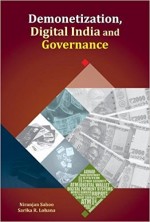
Demonetization, Digital India and Governance
Niranjan Sahoo and Sarika R. Lohana
₹801 ₹870 (8% off)
ISBN 13

9788177084412
Year

2017
The International Monetary Fund has hailed India as a bright spot amidst a slowing global economy. Indian economy has the potential to achieve double-digit growth rate. In spite of being a bright spot on the world map, a host of problems confront India which caste shadow on its governance credentials. These so-called black spots include: (a) black money, (b) corruption, (c) money laundering, (d) counterfeit currency, (e) tax evasion and (f) terrorist financing.
The new Government at the Centre, which took charge in May 2014, under the dynamic leadership of Prime Minister Shri Narendra Modi has a vision to make India a modern and vibrant economy. Policies and programmes to rejuvenate the economy have already been announced in this regard.
It was in the above context that the Government of India decided to withdraw the legal tender character of ` 500 and ` 1,000 banknotes of the Mahatma Gandhi Series from the midnight of November 8, 2016. The announcement was made by no less a person than the Prime Minister himself in an unscheduled live televised address to the nation on the evening of November 8, 2016. The demonetized bank notes accounted for 86 percent of the country’s cash supply.
The use of digital technology—world’s fastest growing economic activity—to improve governance cannot be over-emphasized. Digital technology has become the greatest agent of change and promises to play this role even more dramatically in future. One major objective of the demonetization exercise is to encourage cashless/electronic transactions in the economy. The Government of India has taken policy decision to encourage electronic transactions and has, in this regard, announced a number of incentives.
Technology, competition, and benchmarking to the best international practices have to be the driving force of India’s development efforts. Demonetization exercise needs to be seen in this perspective.
CONTENTS
1. Demonetization of High Denomination Currency Notes in India
1.1 Demonetization Defined
1.2 History and Background
1.3 Prime Minister’s Historic Announcement to Withdraw Legal Tender Character of ` 500 and ` 1000 Banknotes
1.4 Objectives of the Scheme
1.5 Main Features of the Demonetization Scheme
1.6 Package for Promotion of Digital and Cashless Economy
1.7 Reactions to Demonetization
1.8 Pradhan Mantri Garib Kalyan Deposit Scheme, 2016
2. The Menace of Black Money in India
2.1 Black Money Defined
2.2 Global Concerns against Black Money/Tax Evasion
2.3 Sectors/Activities More Prone to Black Money Generation
2.4 Activities Leading to Generation of Black Money
2.5 Methods to Generate Black Money
2.6 Consequences of Black Money/Tax Evasion
2.7 Estimation of Black Money
3. Institutional and Legislative Measures to Curb Black Money
3.1 Agencies for Enforcement of Tax Laws
3.2 Regulatory Authorities for Supervision and Policing
3.3 Co-ordinating Agencies
3.4 Other Agencies
3.5 Recent Legislative Measures to Prevent Generation of Black Money
4. Economics of Digitization and Digital India (DI): Vision 2019
4.1 Economics of Digitization
4.2 Digital Economy and Knowledge Economy
4.3 Digital India (DI): Vision 2019
5. Governance with Digital Tools
5.1 Governance: Theoretical Framework
5.2 Digital Tools for Improving Public Services in India
5.3 Digital Tools for Tax Administration
6. Internet Banking and Mobile Banking
6.1 Internet Banking
6.2 Mobile Banking
7. Digitization of Stock Exchanges
7.1 Corporatisation and Demutualisation of Stock Exchanges
7.2 Depository System, Dematerialisation (Demat) and Rematerialisation
7.3 Infrastructure for Government Securities Market
8. Digital Payment Systems
8.1 Importance of a Sound Payment and Settlement System
8.2 Segments of Payment System
8.3 Large Value Payment Systems
8.4 Retail Payment Systems
8.5 National Payments Corporation of India (NPCI)
8.6 Committee to Review the Framework Related to Digital Payments
8.7 Benefits of Electronic Payments
8.8 Credit/Debit Cards
8.9 ATM Networks
8.10 Digital Wallet
8.11 Aadhaar-enabled Payment System (AEPS)
8.12 Unified Payment Interface (UPI) of India
8.13 Unstructured Supplementary Service Data (USSD): *99# Banking
8.14 RuPay
9. Electronic Money (E-money) and Electronic Commerce (E-commerce)
9.1 Electronic Money (E-money)
9.2 E-money and Digital Money
9.3 Electronic Commerce (E-commerce)
9.4 Internet Marketing
10. Digital Technology for Pradhan Mantri Jan-Dhan Yojana (PMJDY), 2014
10.1 PMJDY: Brief Introduction
10.2 Six Pillars of PMJDY
10.3 Challenges Identified in Implementing the Mission
10.4 Roles of Major Stakeholders
10.5 Use of Digital Technology for PMJDY, 2014
11. Digital Services in Agriculture and Rural Development
11.1 Need for IT-based Services to Farmers
11.2 Rural Portal of Ministry of Rural Development (MoRD)
11.3 National Rural Employment Guarantee Act Software Package (NREGASoft)
11.4 IFFCO-ISRO Cooperation
11.5 Cyber Dhabas
11.6 E-Choupal
11.7 E-Panchayat
11.8 Kisan Call Centres (KCCs)
11.9 National e-Governance Plan in Agriculture (NeGP-A)
11.10 Other IT Services to Agricultural Sector
11.11 Computerisation of Agricultural Census and Input Survey
12. India’s Cyber Security Policy
12.1 What is Cyber Space?
12.2 Need for Cyber Security
12.3 National Cyber Security Policy (NCSP), 2013
Bibliography
Index