
Om Publications
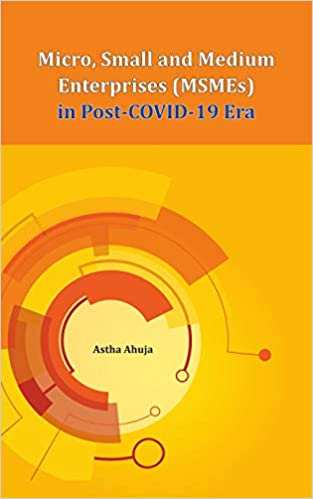
Micro, Small and Medium Enterprises (MSMEs) in Post-COVID-19 Era (Hardback)
Astha Ahuja
₹1131 ₹1285 (12% off)
ISBN 13

9788177085136
Year

2020
As per the Annual Report, 2018-19 of the Ministry of Micro, Small and Medium Enterprises, Government of India, there were 633.88 lakh micro, small and medium enterprises (MSMEs) in the country engaged in different economic activities. Total employment in the MSMEs sector is estimated to be 1,109 lakh, and their contribution to gross domestic product (GDP) is pegged at 28.9 percent. In the wake of COVID-19, it was a particularly challenging time for MSMEs, many of which were on the brink of closing down their operations.
Sensing the gravity of the situation, Prime Minister Narendra Modi announced on May 12, 2020, the Aatmanirbhar Bharat Abhiyan (Self-reliant India Initiative) which combined relief, policy reforms and fiscal and monetary measures to help businesses and individuals cope up with the situation created by COVID-19 pandemic. A mega package of ` 20 lakh crore (10 percent of the GDP) was announced for the purpose.
The details of the ` 20 lakh crore package were announced by Finance Minister Nirmala Sitharaman in five tranches during the next five consecutive days. All the measures were aimed at spurring investment and buffering the economy against the Covid pandemic shock.
In a bid to make MSMEs sector of the economy survive, the Finance Minister in her first tranche of the stimulus, announced on May 13, 2020, laid out specific boosters that could offer some relief to this hard-hit sector. The nearly ` 6 lakh crore tranche, included ` 3 lakh crore collateral-free automatic loans for MSMEs.
Furthermore, from July 1, 2020, a new classification of MSMEs with liberalized definitions is in place.
This book provides a descriptive and analytical account of the functioning of MSMEs in India. It discusses at length their role in the Indian economy, policies and programmes of the Government to promote them, and the problems faced by them.
CONTENTS
Part I: MSMEs in the Indian Economy
1. Micro, Small and Medium Enterprises (MSMEs): Post-Independence Policy Review
1.1 Industrial Policy Resolution, 1948
1.2 Industrial Policy Resolution, 1956
1.3 Industrial Policy Statements 1973, 1977 and 1980
1.4 Industrial Policy Statement, 1991
1.5 Other Developments
1.6 Small-scale Industries in Five Year Plans (I to XII Plan)
1.7 Critical Assessment
2. Why Are MSMEs Strategically Important for Indian Economy?
2.1 Contribution of MSMEs to National Economy
2.2 Advantages of MSMEs
2.3 Factors Determining Performance of MSMEs
2.4 Nature of MSMEs
3. Impact of COVID-19 on Indian Economy
4. New Classification, Definitions and Package for MSMEs
4.1 Micro, Small and Medium Enterprises Development (MSMED) Act, 2006
4.2 Aatmanirbhar Bharat Abhiyan (Self-reliant India Initiative) and MSMEs
5. MSMEs and Goods and Services Tax (GST)
5.1 Goods and Services Exempted from GST
5.2 Goods and Services Supplied by Businesses within Prescribed Threshold Limits of Aggregate Turnover
5.3 Composition Levy Scheme
5.4 Soft Tax Rate Policy for MSMEs
5.5 Simplified Compliance Procedures for MSMEs
5.6 Sector-specific Concessions and Reliefs
Part II: Institutional Set Up for MSMEs
6. Ministry of Micro, Small and Medium Enterprises (MSMEs)
6.1 Functions
6.2 Organizational Set-up
6.3 Office of Development Commissioner (DC-MSMEs)
6.4 National Small Industries Corporation (NSIC)
6.5 National Entrepreneurship Development Institutes
6.6 National Institute for Micro, Small and Medium Enterprises (NI-MSME)
6.7 MSME Development Institutes (MSME-DIs)
6.8 Technology Centres (TCs)
6.9 MSME Testing Centres (MSME-TCs)
6.10 MSME Testing Stations (MSME-TSs)
7. National Small Industries Corporation (NSIC)
7.1 Marketing Support to MSMEs
7.2 Raw Material Distribution
7.3 Credit Support to MSMEs
7.4 Performance and Credit Rating Scheme
7.5 Technology Support
7.6 Infomediary Services
7.7 Software Technology Parks
7.8 Incubation of Unemployed Youth for Setting up of New Micro and Small Enterprises
7.9 International Co-operation
7.10 International Consultancy Services
7.11 Insurance of Export Credit for Micro and Small Enterprises
8. Other Organizations for the Promotion of MSMEs
8.1 Khadi and Village Industries Commission (KVIC)
8.2 Coir Board
8.3 Mahatma Gandhi Institute for Rural Industrialisation (MGIRI)
Part III: Problems of MSMEs and Remedial Measures
9. Problems of MSMEs
9.1 Credit Constraints
9.2 Inadequate and Irregular Supply of Raw Materials
9.3 Lack of Infrastructural Facilities
9.4 Marketing Handicaps for MSMEs
9.5 Technological Obsolescence
9.6 Social Security Concerns for the Unorganized Workers
10. Policies and Programmes to Help MSMEs
10.1 Reservation of Items for Exclusive Production by Small-scale Industries
10.2 National Manufacturing Competitiveness Council (NMCC)
10.3 National Manufacturing Policy (NMP)
10.4 Rajiv Gandhi Udyami Mitra Yojana (RGUMY)
10.5 Scheme of Fund for Regeneration of Traditional Industries (SFURTI)
10.6 Prime Minister’s Task Force on Micro, Small and Medium Enterprises
10.7 Support Package for Start-ups in Emerging Areas
10.8 Insolvency and Revival of Sick Unit
10.9 Support and Outreach Initiative for MSME Sector, November 2018
10.10 Udyog Aadhar
11. MSMEs in Special Areas
11.1 North East Region (NER)
11.2 Jammu and Kashmir (J&K)
12. Credit Flow to MSMEs Sector
12.1 Working Group on Flow of Credit to the Small and Medium Enterprises (SMEs), 2004
12.2 Group to Review Guidelines on Credit Flow to SME Sector, 2005
12.3 Policy Package for Credit to Small and Medium Enterprises, 2005
12.4 Working Group on Credit Delivery to Micro and Small Enterprises Sector, 2008
13. Technology, Skill Development and Training
13.1 Technology Upgradation
13.2 Skill Development and Training
13.3 National Policy for Skill Development and Entrepreneurship (NPSDE), 2015
14. Marketing and Trade
14.1 Public Procurement Policy
14.2 Consortia Formation and Brand Building
14.3 Legally Recognized Haats and Shandies
14.4 Other Support Measures
14.5 Opportunities Offered by Globalization
15. Cluster-oriented Approach to MSMEs
15.1 What is an Industrial Cluster?
15.2 Potential Benefits of a Cluster
15.3 Importance of Clustered Micro and Small Enterprises
15.4 Determinants of Cluster Development
15.5 Role of Government
15.6 Role of Non-government Agencies
15.7 MSMEs Clusters in India
16. Micro Units Development and Refinance Agency (MUDRA) and Pradhan Mantri MUDRA Yojana (PMMY)
16.1 What is MUDRA?
16.2 Services Offered by MUDRA
16.3 Pradhan Mantri MUDRA Yojana (PMMY)
16.4 Purpose of MUDRA Loan
16.5 MUDRA Card
16.6 Development and Promotional Support
16.7 Pricing of MUDRA Loans
16.8 MUDRA in the Budget for 2018-19
Part IV: Sector-wise Profiling of MSMEs
17. Khadi and Village Industries (KVI)
17.1 Importance and Features of Khadi Sector
17.2 Khadi and Village Industries Commission (KVIC)
17.3 Major Schemes Being Implemented by KVIC
17.4 Other Initiatives to Promote KVI
18. Coir Industry
18.1 Importance and Features of Coir Industry
18.2 Coir Board
18.3 Activities/Schemes for the Development of Coir Industry
18.4 Challenges to Coir Industry
19. Handlooms, Powerlooms and Handicrafts
19.1 Handlooms
19.2 Powerlooms
19.3 Handicrafts
20. Silk and Sericulture, Unorganised Wool Sector and Food Processing Industry
20.1 Silk and Sericulture
20.2 Unorganised Wool Sector
20.3 Food Processing Industry
Bibliography
Index